
Competitor price monitoring is the process of tracking your rivals' prices, discounts and stock levels on a fixed schedule, so you can react before you lose the sale. For most online stores today, that schedule has to be daily or faster.
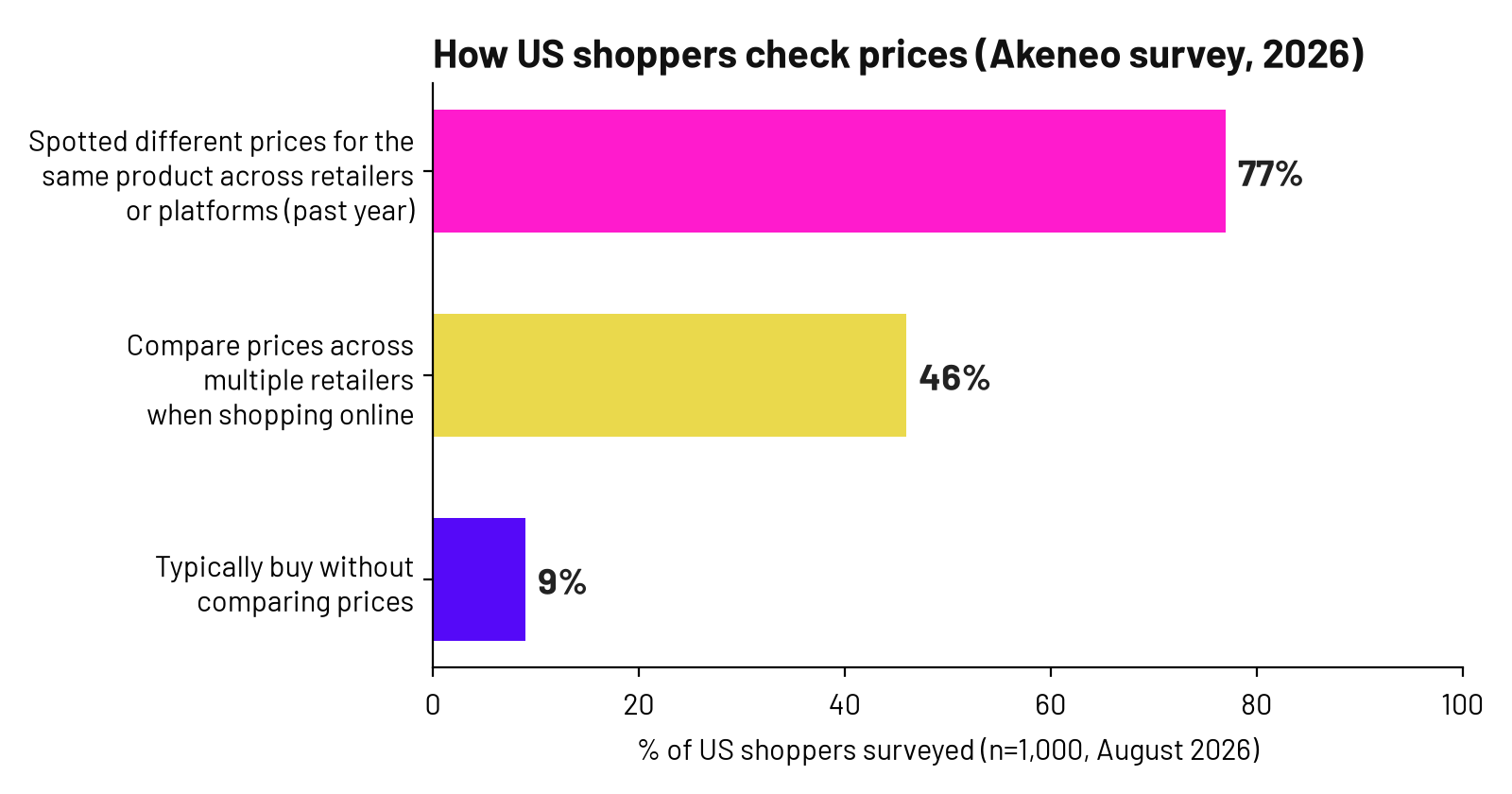
The reason is that shoppers check. A September 2026 Akeneo survey of 1,000 US shoppers found that 46% of shoppers compare prices across multiple retailers online, while only 9% buy without comparing. The same survey found 77% have spotted price differences for the same product across retailers or platforms. If your price is ₹20 higher, a big share of buyers will see it and leave.
What Is Competitor Price Monitoring?
At its simplest, competitor price monitoring means you know a rival's price before your customer does. A tool or service visits competitor product pages, records the price and other details, matches each product to your own catalogue, and shows you the gaps.
Brands usually buy competitor price monitoring services instead of building this themselves. The hard parts are product matching and keeping scrapers working when sites change.
Why Can't You Track Prices Manually?
Two reasons: speed and scale.
Online prices move fast. The price of any given item on Amazon.com changes every 10 minutes, on average, according to a 2019 Axios report, a figure that traces back to a 2018 Business Insider excerpt from the book Swipe to Unlock. Now multiply that by 500 SKUs (stock keeping units, your individual products) across five competitors. That's 2,500 price points to check, many times a day.
Manual tracking also misses things. A person checking a spreadsheet won't notice a flash sale at 11 pm or a competitor going out of stock on a Sunday.
What Should You Track?
Price alone isn't enough. Track the full offer the shopper sees.
| What to track | Why it matters |
|---|---|
| Selling price vs MRP | Shows the real discount depth |
| Coupons and bank offers | Can cut the final price by 10% or more |
| Delivery and handling fees | Change the true cost to the buyer |
| Pack size and unit price | ₹/kg or ₹/litre is the only fair comparison |
| Stock status | Out-of-stock rivals are your chance to win sales |
| Seller name | Catches unauthorized sellers and MAP breaks |
MAP stands for minimum advertised price, the lowest price a brand allows sellers to show publicly.
How Do Competitor Price Monitoring Services Work?
- Pick competitors and products. You share your SKU list and the sites to watch.
- Match products. The service links each of your products to the same item on each competitor site, using barcodes, model numbers or titles and images.
- Scrape on a schedule. Prices are collected daily, hourly or near real-time.
- Clean and compare. Wrong matches and duplicates are removed, and price gaps are calculated.
- Deliver and alert. You get a dashboard, a feed into your repricing tool, or alerts when a rival drops its price.
Why Is Grocery the Hardest Category to Monitor?
Grocery data scraping is tougher than scraping electronics or fashion, for four reasons.
First, the market is moving online fast. In the US, online sales accounted for about 72% of total grocery dollar growth in 2025, and FMI and NIQ project that US online grocery sales will reach $452 billion by 2028. In India, quick commerce is estimated at INR 1.08 lakh crore in 2026, growing 40% year on year, per an Equirus report on India's digital commerce market.
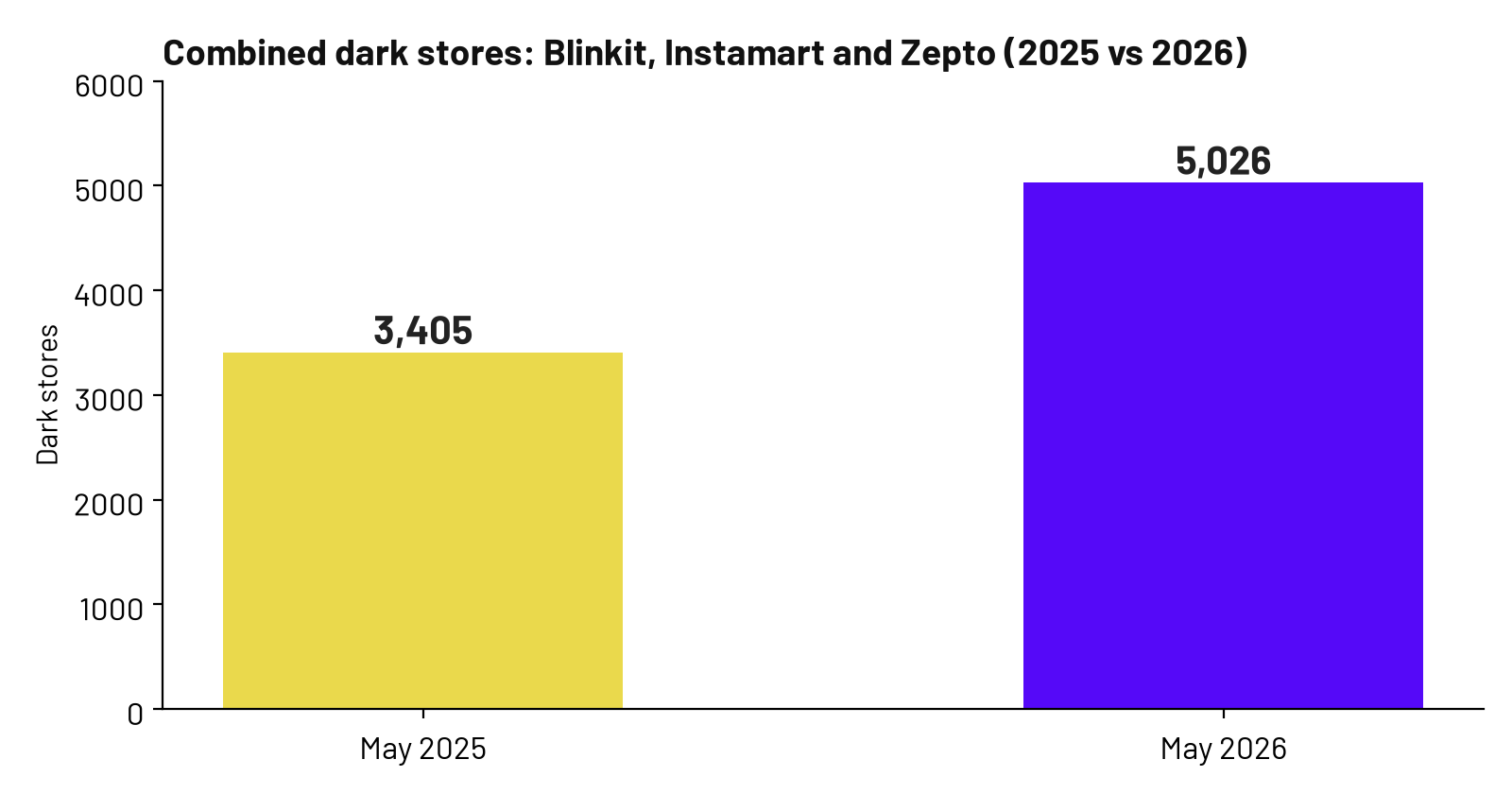
Second, prices change by location. Quick commerce apps price at the dark store level (a small warehouse that serves one neighbourhood). The combined dark-store networks of Blinkit, Instamart and Zepto expanded to 5,026 locations in May 2026, up from 3,405 a year earlier, according to the same Equirus report. One national price check tells you very little.
Third, the gaps between platforms are big. When Flipkart entered quick commerce in August 2024, Inc42 reported a price difference of as much as 24% on items such as Britannia Milk Bread against Blinkit. Fees differ too. A November 2025 Financial Express analysis of quick commerce fees found that on orders below ₹99, Zepto charged ₹30 as a delivery fee, while Blinkit imposed ₹54 in total fees. Both apps have changed their fees since, so fees need tracking too.
Fourth, prices may differ by device. In one widely shared case of device-based pricing, a user reported that on Zepto 500 grams of grapes were priced at Rs 65 on an Android device but Rs 146 on an iPhone. Whatever the reason, it means good grocery data scraping has to check prices from more than one device type and location.
So what do we do? If you sell groceries or FMCG products, ask any provider how many pincodes they cover, how often they refresh, and whether they capture fees and pack sizes along with the shelf price.
What Do You Do With the Price Data?
Collecting data is only half the job. Here's how brands use it:
- Set pricing rules, for example "stay within 3% of the lowest competitor, but never below cost".
- Time promotions around competitor sales instead of guessing.
- Push ads harder in areas where a rival is out of stock.
- Flag sellers who break your MAP, and act on it within the day.
- Spot pack-size games, where a rival shrinks the pack but keeps the price.
How to Choose Competitor Price Monitoring Services
Before you sign with any of the competitor price monitoring services on your list, check these:
- Matching accuracy, verified on a sample of your own SKUs
- Coverage of every site you compete on, including quick commerce apps
- Pincode or city-level pricing for grocery
- A refresh rate that fits your category
- Capture of fees, coupons and unit prices, not just shelf price
- Delivery into your tools (dashboard, Google Sheets, API or repricer)
- A written fix time for when a site changes
FAQs
How often should I monitor competitor prices?
Grocery and electronics usually need several checks a day. Slower categories like furniture can work with daily checks.
Is competitor price monitoring legal?
Collecting publicly visible prices is generally considered low risk, because prices are facts anyone can see. Avoid scraping behind logins or collecting personal data, and check with a lawyer for your specific market.
Can small brands afford it?
Yes. Many services price by the number of SKUs tracked, so you can start with your top 50 products.
Final Word
Your competitors change their prices whether you're watching or not. Competitor price monitoring makes sure you see the change before your customer does.
Leave A Comment